


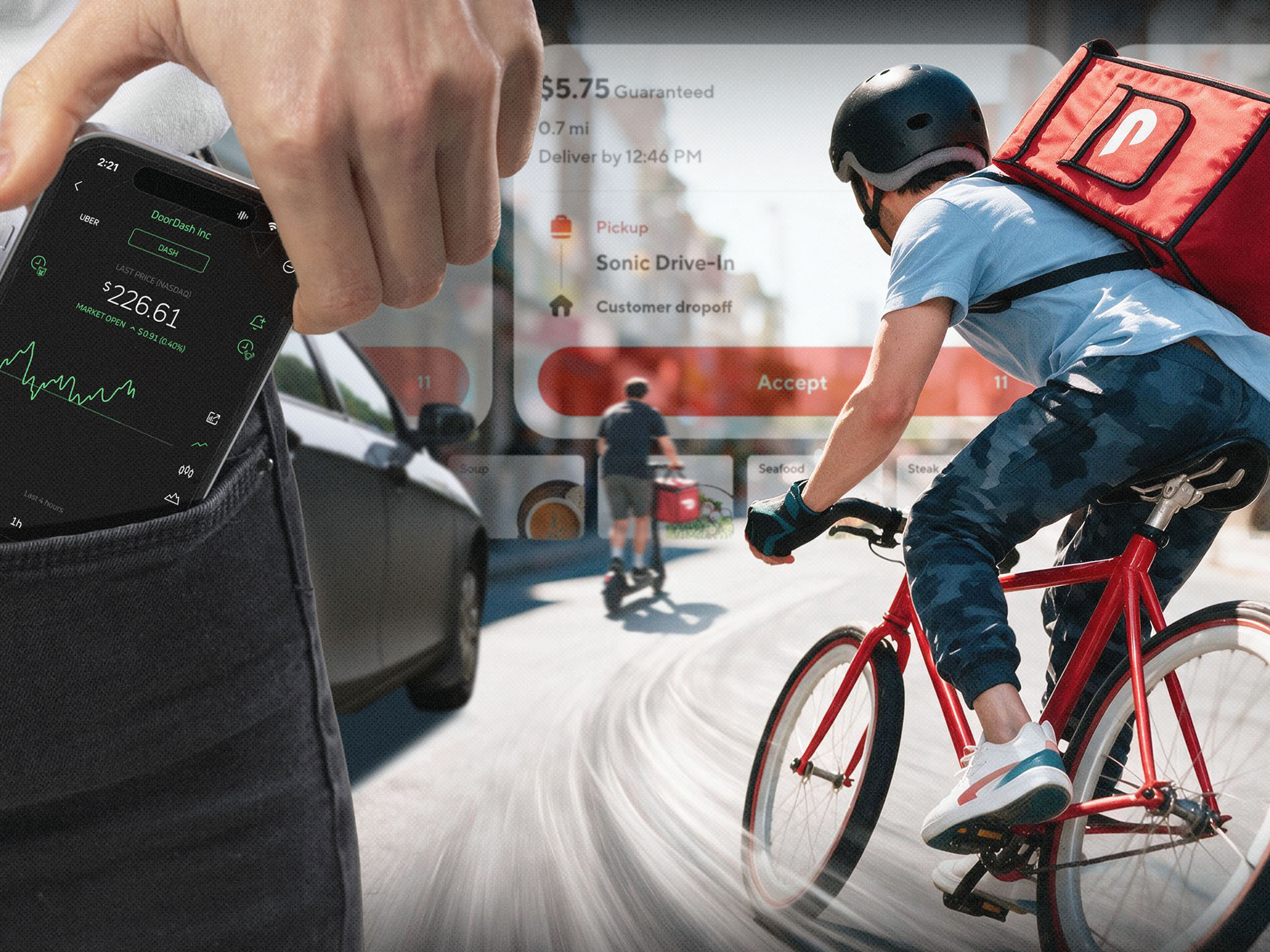


Consumer demand for quick delivery of restaurant food and other items has created a market for delivery companies, and 13-year-old DoorDash (NASDAQ: DASH) is leading the way.
It is far and away No. 1 in the North American food and convenience delivery market, with a 65% market share. Uber Eats (NYSE: UBER) is second at 30%. DoorDash doesn’t break down its revenue by segment, but restaurants make up the overwhelming majority of its business, though the grocery and retail sectors are growing fastest.
DoorDash operates as an on-demand logistics platform connecting customers, local merchants, and independent delivery drivers to facilitate the purchase and delivery of consumer goods.
Customers enter their orders online and pay service fees, delivery fees and tips. Merchants pay a commission to DoorDash. Its stock has generated an annualized total return of 40% over the past three years.
The company’s large network helps its success multiply – a “flywheel effect,” as Morningstar analyst Mark Giarelli calls it. “As more orders are placed, more data is collected,” he noted in a report. “This data enhances algorithms, which then improve the application’s understanding of human behavior and encourage more orders.”
‘Virtuous cycle’
DoorDash is locked in to a good dynamic. “We think this virtuous cycle will persist, and DoorDash will remain a leader in the growing industry,” Giarelli said. He sees the global market for food and convenience delivery expanding 10%-15% annually through 2032, with a total addressable market of $300 billion.
DoorDash posted strong earnings in the second quarter. Orders soared 27% from a year ago, 17% excluding its October 2025 acquisition of Deliveroo. That’s a U.K. delivery company that operates throughout Europe, the Mideast and Asia Pacific. DoorDash’s revenue jumped 36% in the second quarter, 24% excluding Deliveroo. Adjusted EBITDA surged 40%.
Speaking of Deliveroo, it pushed the number of countries where DoorDash does business to more than 40. And it has a strong opportunity to expand further overseas, analysts say.
That’s not the only area for potential growth. “We are particularly excited about DoorDash’s opportunity in grocery and drone delivery, which could drive significant margin expansion in the years to come,” Giarelli said.
You can add retail to that too. Grocery and retail delivery are on track to become profitable in the second half of this year, he said. ‘Improving economics, as measured by revenue per order and revenue per user, suggest that scale is translating into more profitable growth.”
Benefits of DashPass
DoorDash benefits greatly from its DashPass program. That’s a premium subscription service which gives members free delivery and reduced service fees. It costs $9.99 a month or $96 per year. DashPass members drove 75% of U.S. grocery and retail orders in the second quarter.
And in the 12 months through June 30, the company increased its U.S. DashPass memberships by more than it did over the previous 24 months, it said.
The growth of DoorDash’s grocery and retail business should buttress its network effect by increasing order density, Henry Ellenbogen chief investment officer at Durable Capital Partners, told Barron’s. “Higher density translates to efficient order batching and better unit economics.”
DoorDash isn’t the only competitor in its field with a network effect, “but only Uber can compare to DoorDash’s scale,” Giarelli explained. “And even there, DoorDash has far superior customer engagement.”
DoorDash also is making the most of artificial intelligence. “Its continually improving machine-learning algorithms should enable increased order batching and higher route density, enhancing efficiency,” he said.
So perhaps DoorDash will continue to “deliver right on time,” to borrow from the 1972 Rolling Stones song “Let it Loose.”


Comments